

Endotoxin contamination discovered at final quality control can put valuable material, manufacturing time and resources at risk. Testing at selected stages during production gives manufacturers an earlier opportunity to identify concerns and investigate their source.
For modern biopharmaceutical products, implementing that testing is not always straightforward. Complex sample matrices, limited sample volumes and demanding turnaround times can make routine monitoring difficult.
This article explores those challenges and explains how αBET® technology can support a more practical approach to in-process endotoxin testing.
Endotoxin control beyond water quality
Water quality remains central to endotoxin control in pharmaceutical manufacturing. Modern biopharmaceutical processes also introduce biological materials, formulation components and multiple processing stages that require consideration.
For cell and gene therapies, recombinant proteins and other complex products, monitoring water alone does not provide a complete picture of process risk. Testing relevant inputs and intermediates can help identify potential contamination before further manufacturing adds time and cost.
The value of in-process monitoring therefore depends on obtaining reliable results early enough to inform a meaningful decision. [1,2]
Testing challenges in cell, gene and oligonucleotide products
Cell-based therapies, oligonucleotides, and both viral and non-viral vectors provide fresh, distinct challenges for endotoxin testing laboratories. Matrix interferences, low endotoxin recovery (LER), and light-scattering formulations contribute to widespread problems for both chromogenic and turbidimetric Limulus Amebocyte Lysate (LAL) assays [3].
Optical Interferences: High concentrations of oligonucleotides can give rise to naturally cloudy solutions. This is highly problematic for conventional turbidimetric assays that monitor an increase in the reaction mixture's cloudiness. Simultaneously, chromogenic assays can be unreliable because the absorbance spectra of oligonucleotides often overlap with the wavelength used to monitor the production of the chromophore.
Chemical Inhibition: Nucleotides form complexes with endotoxins while also strongly chelating divalent cations, which are essential co-factors of the LAL reaction. Both mechanisms inhibit the reaction and lead to lower-than-anticipated endotoxin recovery. While sample preparation can require significant dilution to control this assay interference, this approach often results in exceeding the maximum valid dilution (MVD) [1, 2].
Process and Operational Risks: The multi-stage manufacturing process of cell therapy products—spanning collection, transduction, expansion, and formulation—compounds the risk of endotoxin contamination at multiple steps. Given the high costs and labour-intensive nature of cell and gene therapy production, manufacturers must identify contamination during production rather than waiting for batch completion.
Volume and Speed Constraints: The test volumes required for traditional tube- and plate-based assays can be unsustainably large relative to total product volume, while slow turnaround times directly conflict with challenging time-to-patient constraints. Additionally, the consumable cost for existing rapid cartridge-based systems remains prohibitive to implementing a robust, routine in-process control and monitoring strategy.
Testing challenges in proteins and antibodies
Recombinant antibodies and proteins are frequently associated with higher background endotoxin levels, particularly when produced using E. coli expression systems. Consequently, the targeted removal of endotoxins during the purification process is essential to ensure the final product meets required specifications, making continuous process monitoring mandatory for product quality assurance. However, these formulations introduce severe technical hurdles to traditional testing:
Protein formulations are notoriously prone to endotoxin masking. This leads to low endotoxin recovery and the dangerous potential under-reporting of actual endotoxin levels. Furthermore, high-concentration therapeutic antibodies can be strongly light-scattering, which actively interferes with both chromogenic and turbidimetric LAL assays. [4]
Balancing dilution and sensitivity: Just as with cell and gene therapies, resolving these severe matrix interferences requires significant sample dilution, which often forces the sample to exceed its maximum valid dilution (MVD). Furthermore, the sample volumes required for traditional assays do not align well with smaller manufacturing scales.
Supply Chain Bottlenecks: A slow turnaround of testing results increases overall time-in-tank. This slows down active manufacturing phases and delays the ultimate release of the therapeutic products to market.
What makes routine in-process testing difficult?
The benefits of earlier endotoxin detection are clear, but implementing routine monitoring requires a testing approach that fits the manufacturing workflow. Alongside the analytical challenges described above, several practical factors can limit its usefulness. [1,5]
Results need to arrive in time to inform decisions
Sample transport, laboratory scheduling and assay duration can delay results. If manufacturing has already moved to the next stage, the opportunity to respond to an emerging issue may be reduced.
Sample and reagent consumption must be manageable
For high-value, low-volume products, repeated sampling can consume a meaningful proportion of the available material. Sample and reagent requirements therefore become important when assessing the feasibility of additional testing points.
Testing must fit the working environment
Instrument size, operator training, sample preparation and data handling all influence where and how testing can be performed. A method that works well in a central laboratory may require adjustments before it can support testing closer to production.
Recurring costs must support a sustainable programme
Consumable costs accumulate as testing frequency increases. Manufacturers need to balance the value of additional monitoring with the cost of maintaining it across multiple stages and batches.
A practical in-process testing approach must combine reliable analytical performance with suitable turnaround, manageable sample requirements and a workflow that teams can sustain.
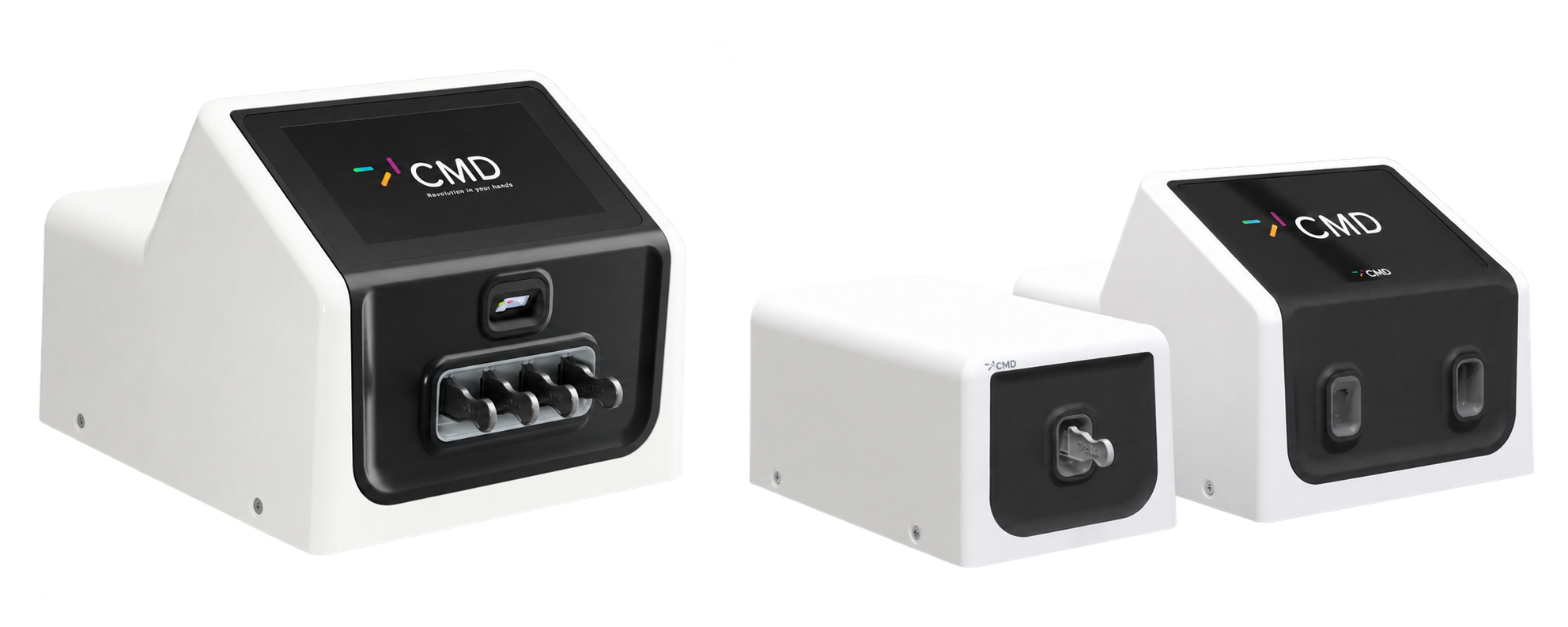
The solution: CMD’s 𝜶BET® platform
The 𝜶BET® range of instruments is the first major innovation in endotoxin testing in over twenty years. Unlike conventional optical readers, detection is independent of wavelength and relies on the interaction of light with rotating magnetic nanorod reporters, the rotational behaviour of which is extremely sensitive to the changes in the nature of the sample as the LAL reaction proceeds. It is extremely robust being tolerant to coloured, hazy, complex macromolecular and nanoparticle or cell containing formulations and excipients. [6]
Furthermore, since it is the orientation of the reporters that change as the LAL reaction progresses and not the magnitude of the optical signal, variations in signal strength has no effect on the assay. Importantly, detection is also wavelength independent therefore providing an opportunity to select a wavelength that is little absorbed by complex or coloured samples.
Therefore, the 𝜶BET® runs turbidimetric LAL assays in the near infra-red at 850nm - from an area of the spectrum commonly referred to as the ‘biological window of opportunity’.
The consequence of this is that interferences that compromise the transmission of light - due to scatter, absorbance or reflection - have little to no influence on the assay provided a minimum signal level is achieved.
Making in-process monitoring useful
An effective monitoring programme needs suitable sampling points, reliable methods and results available in time to inform the next manufacturing decision.
For complex biopharmaceutical products, this means addressing analytical challenges alongside practical considerations such as sample volume, turnaround and recurring cost.
To explore how αBET® could support your workflow, visit our in-process endotoxin testing page or speak to the CMD team.
References
[1] U.S. Food and Drug Administration. (2026). Pyrogen and Endotoxins Testing: Questions and Answers: Guidance for Industry (Rev. 2). Center for Drug Evaluation and Research (CDER). FDA Guidance Document
[2] European Medicines Agency. (2025). Concept paper on the revision of Part IV of the EU Guidelines on Good Manufacturing Practice specific to Advanced Therapy Medicinal Products (ATMPs). European Commission. ECA GMP Compliance Briefing
[3] FireGene Knowledge Center. (2026). Endotoxin testing for cell & gene therapy: Unique challenges, regulatory expectations, and best practices in 2026. FireGene Literature. FireGene CGT Guide
[4] Schwarz, H., Gornicec, J., Neuper, T. et al. Biological Activity of Masked Endotoxin. Sci Rep 7, 44750 (2017). https://doi.org/10.1038/srep44750
[5] ECA Academy. (2026). Regulators approve post-approval change protocol for endotoxin testing: From LAL to recombinant methods. European Compliance Academy
[6] Cotton Mountain Diagnostics Ltd & αBET® https://www.cm-dx.com/